AlpineDC Private Suites in Crissier
In Crissier, near Lausanne, AlpineDC operates two private suites within the BrainServe datacenter, with colocation, housing and IP connectivity operated on its AS198385 network.
Near Lausanne
Located in the canton of Vaud, in the heart of French-speaking Switzerland, with direct road access and optimal regional connectivity.
AlpineDC private rooms
AlpineDC operates two private rooms in Crissier: one suited to traditional density, the other designed for high density.
Security and 24/365 operations
Biometric access control, video surveillance, intrusion detection and on-site presence continuously for equipment protection.
Site overview
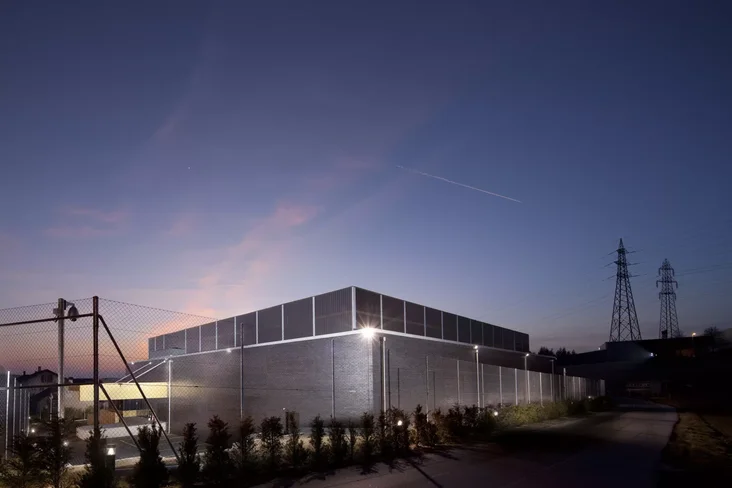
In Crissier, AlpineDC operates two private suites within the BrainServe datacenter. Located in the canton of Vaud, near Lausanne, this site provides an environment suited to hosting critical infrastructure for businesses, operators and hosting providers.
Its location in French-speaking Switzerland enables rapid access from the region’s main economic hubs, while benefiting from the legal and technical stability of the Swiss framework. The site is operated in a dedicated building, with reinforced physical security and infrastructure designed for service continuity.
The Crissier datacenter is operated by BrainServe SA. AlpineDC offers its colocation, housing, dedicated server, VPS and IP connectivity services there, with local technical support in French, English and German.
Certain infrastructure characteristics mentioned on this page are based on information provided by BrainServe SA, the site operator.
Infrastructure
Building and environment
The building is constructed in concrete structure on 4 levels, with no exterior windows, and has a volume of approximately 22,000 m³. The site covers 6,432 m². According to information provided by the site operator, the usable floor area includes approximately 2,000 m² of hosting rooms, 100 m² of telecom rooms, 100 m² of storage space and 65 m² of shared workspace.
AlpineDC has two private rooms on this site, operated directly: one is designed for traditional density needs, the other for high-density needs.
Power and redundancy
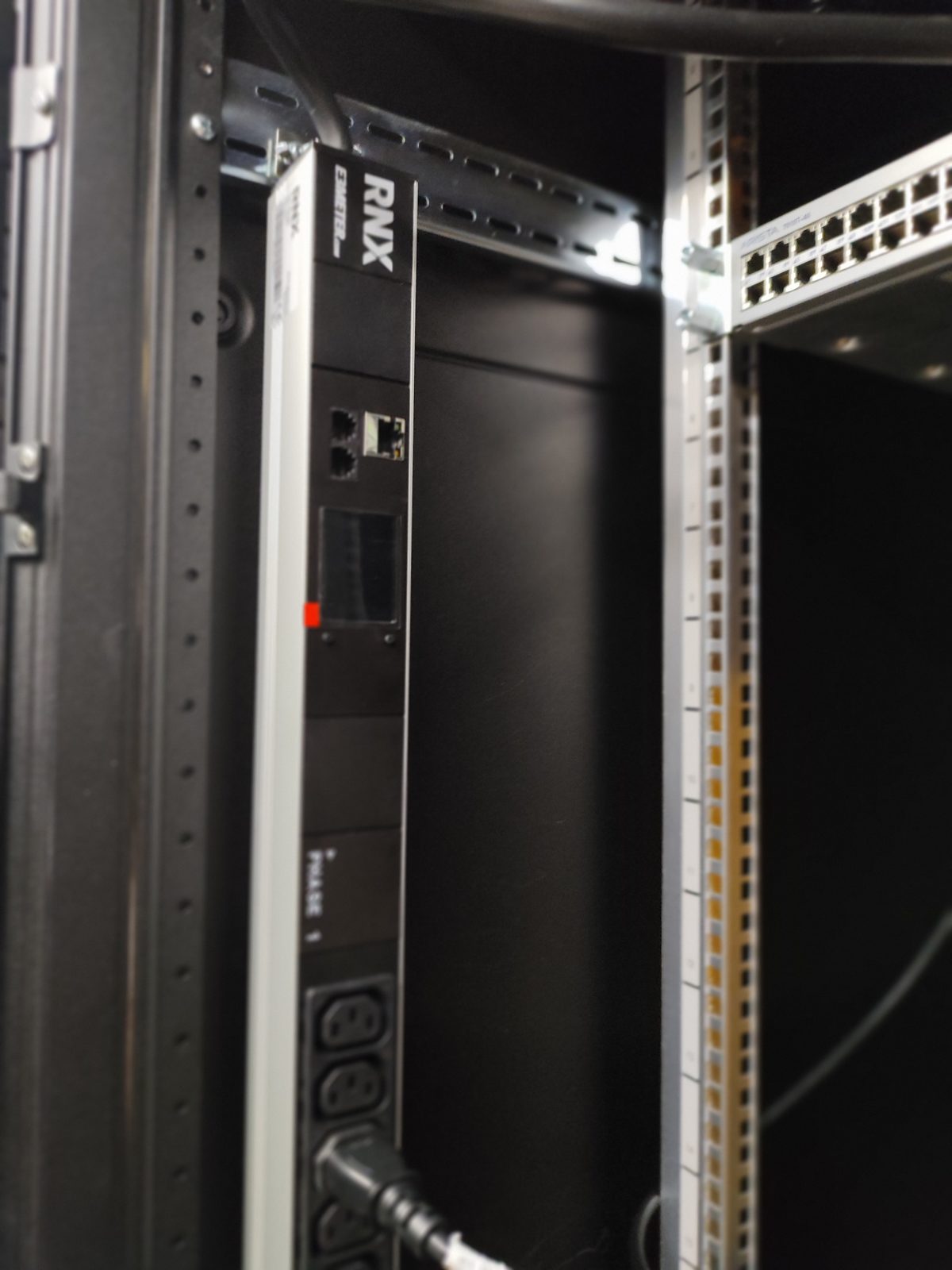
The guaranteed electrical power is 10 MVA, with an on-site transformation substation equipped with 5 transformers of 2,500 kVA in an N+1 configuration. The site’s electrical distribution relies on a redundant architecture, with secure power supply according to information provided by BrainServe. The electrical availability announced by the operator reaches 99.999 %. Diesel generators are present on site, with an announced autonomy of 80 hours at full load.
Cooling
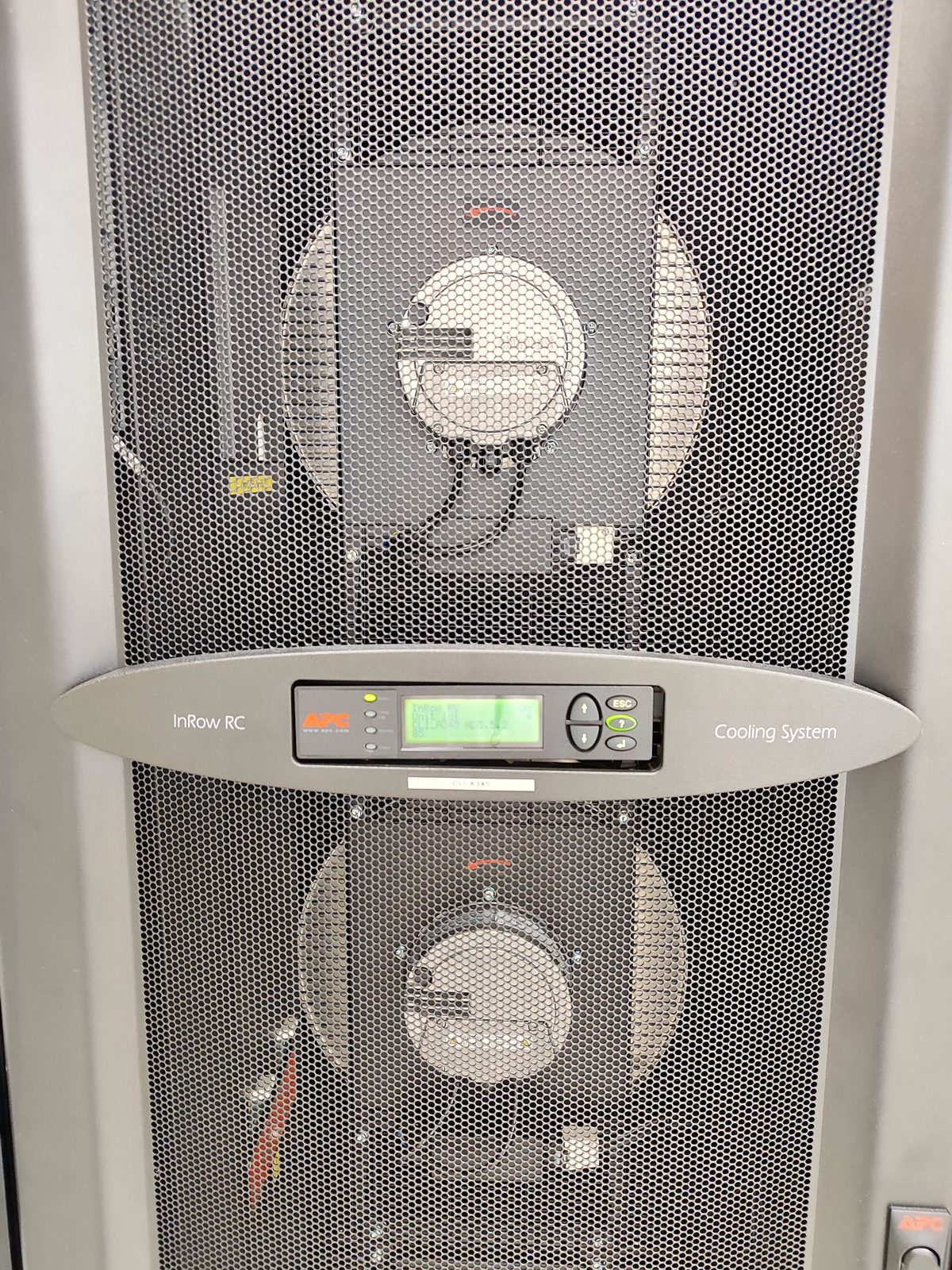
According to information provided by BrainServe, chilled water production and distribution rely on an N+N redundant architecture, while air handling units are announced as N+1. The site also incorporates free cooling and containment devices suited to high-availability technical environments, as well as leak detection on cooling networks and interior/exterior drainage for water protection.
Physical security and operations
Physical security relies on several layers: fenced site, secure reception, mantrap, biometric access control, audio and video surveillance, intrusion detection, and 5 levels of containment. Fire protection combines general detection with a Hi Fog system (zone-based water mist) and firewalls.
Site operations are ensured with a 24/7, 365-days-a-year on-site presence, primarily structured around the ISO 20000 and ITIL frameworks.
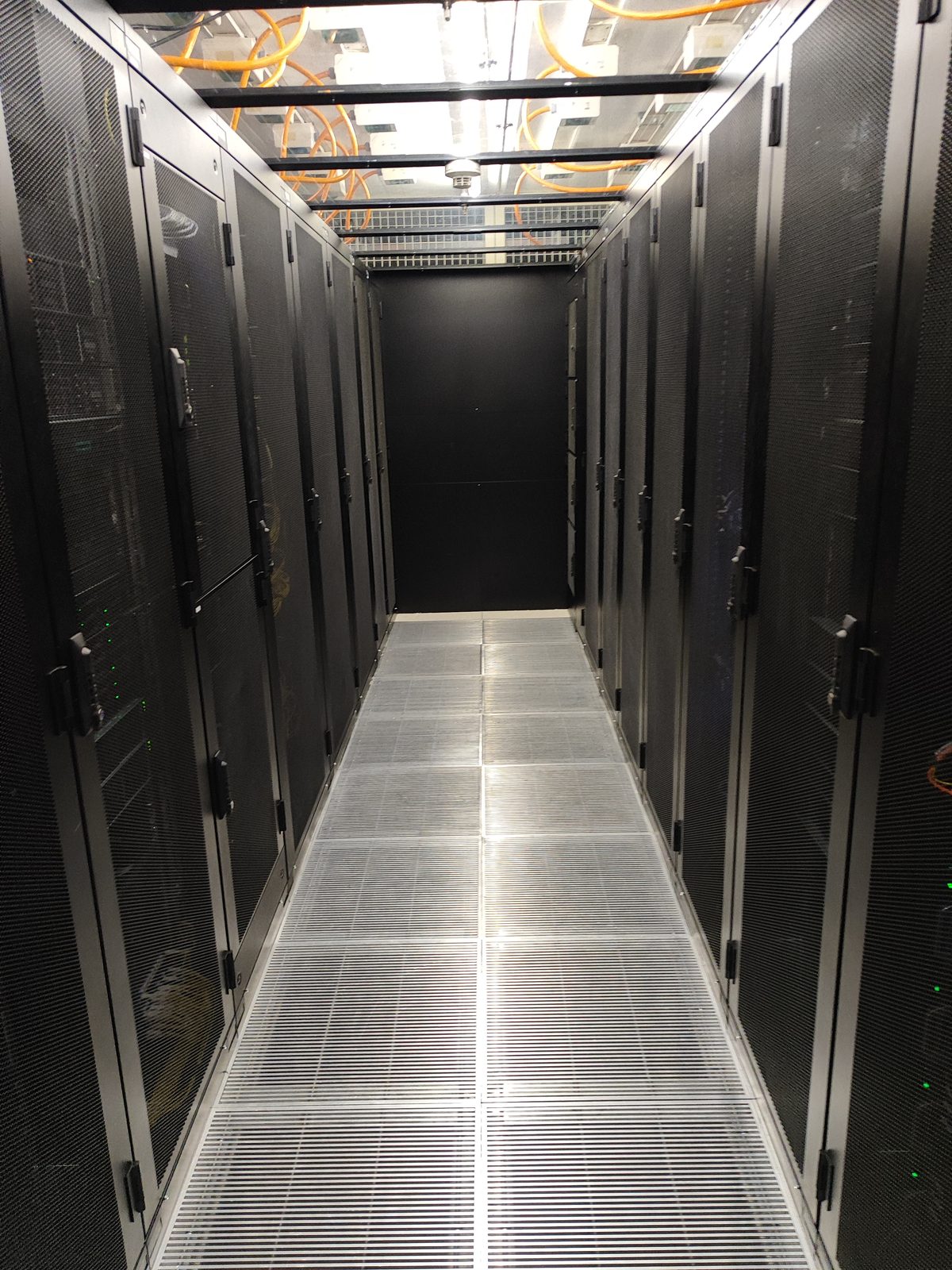
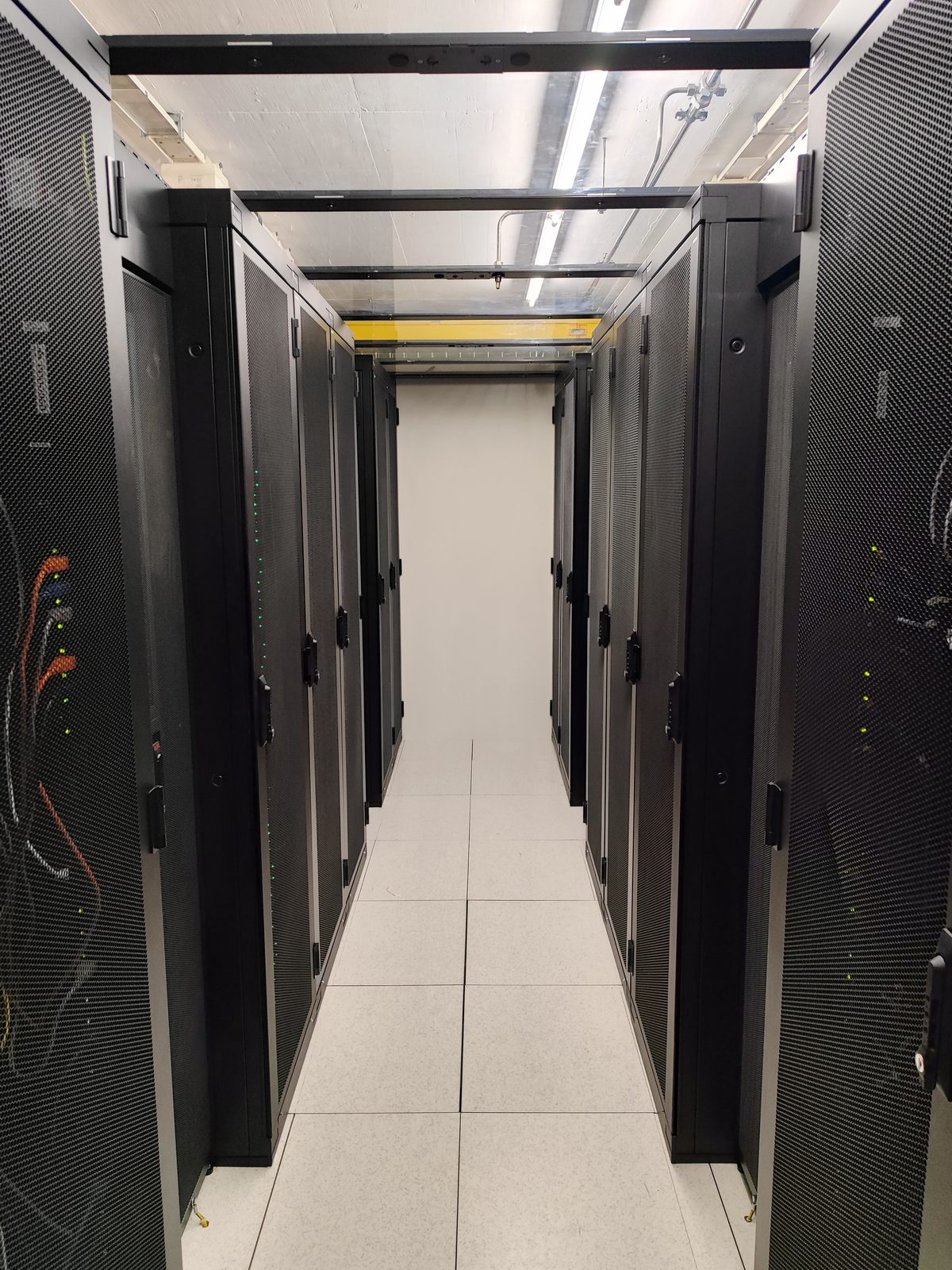
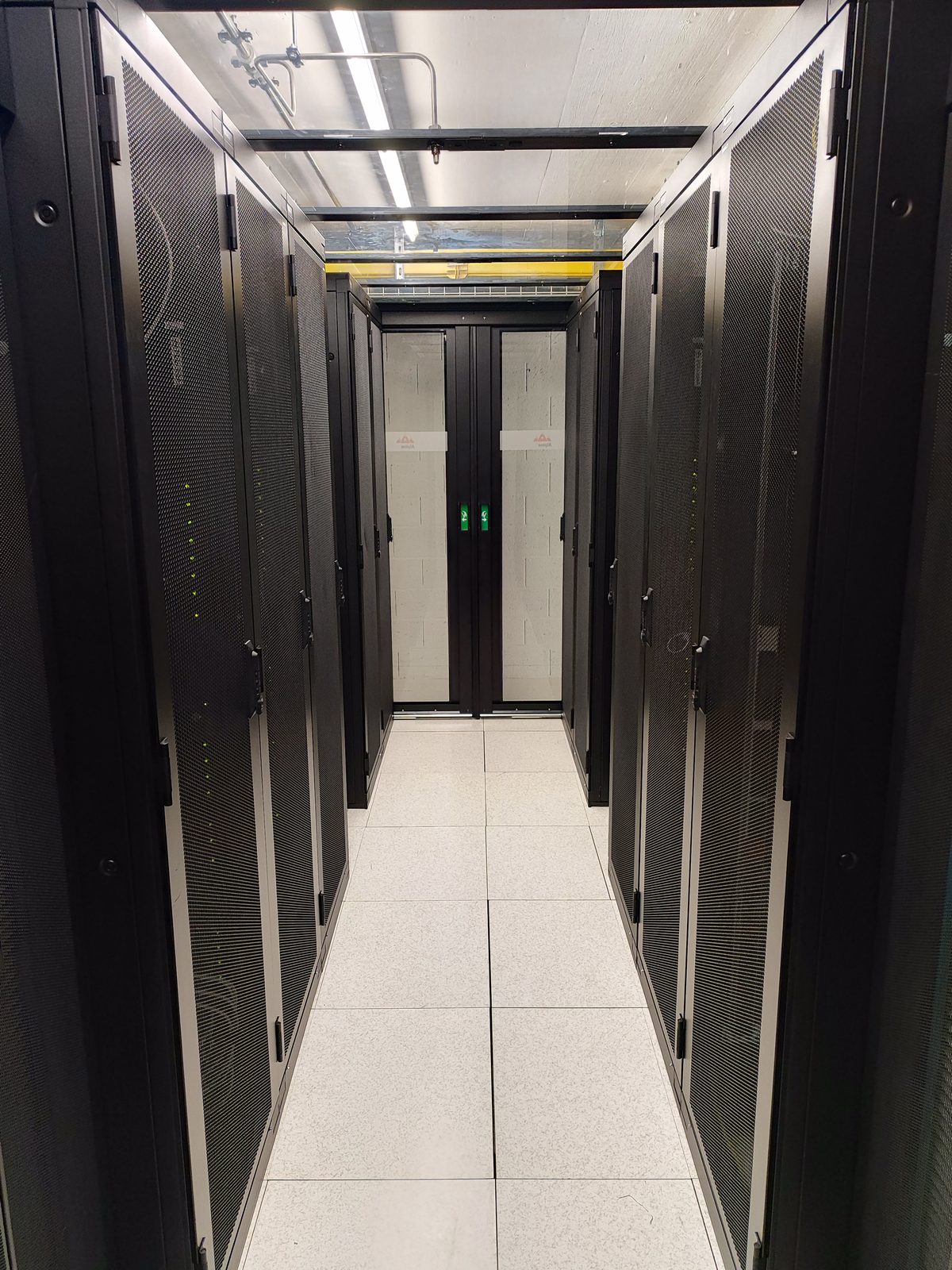
Standard colocation room — Cold corridor
The standard colocation room is arranged in hot and cold aisles (cold corridor) to optimise heat dissipation and energy efficiency. This environment hosts customer equipment in colocation.
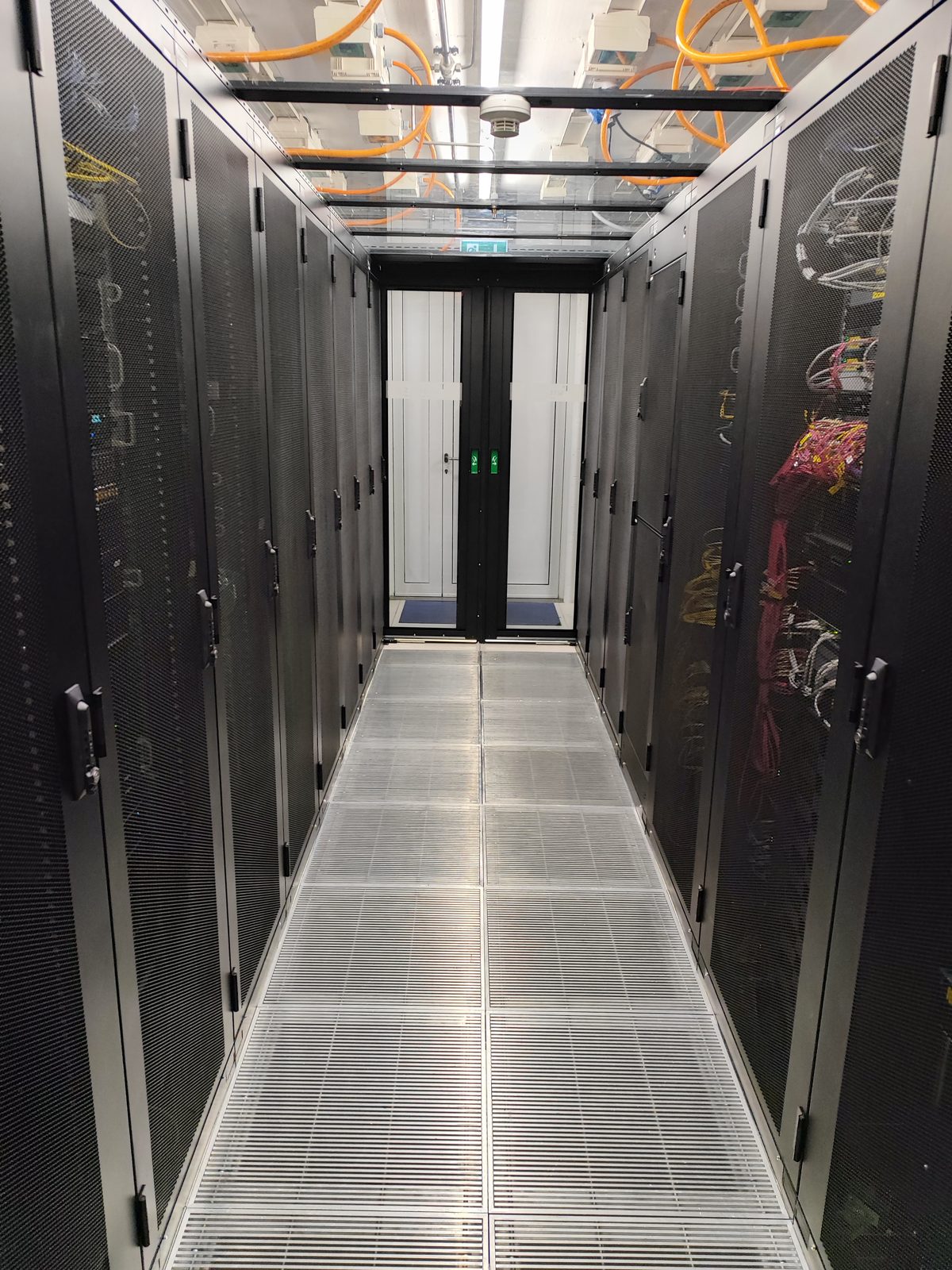
High-density room — Hot corridor
The high-density room is designed for private colocation needs requiring high power per rack. Arranged in hot aisles, it incorporates reinforced cooling and dedicated electrical supply to support high loads.
Cooling and power
Cooling and electrical distribution form the foundation of service continuity. The site combines free cooling, N+N redundancy and units powered by high-availability architectures.
Connectivity
AlpineDC's private suites in Crissier are interconnected with the autonomous AS198385 network, operated directly by AlpineDC. This network mastery enables routing policies, resilience and latency to be controlled for each customer. The site benefits from multi-transit connectivity and active peering on the main European exchange points.
- Autonomous network operated in-house (AS198385)
- Multi-transit for resilience and IP path optimisation
- Peering on SwissIX, RomandIX, France-IX and DE-CIX
- Native IPv4 and IPv6 addressing, with expansion capability
- Link redundancy and scalability according to needs
According to information provided by the site operator, the datacenter has a fibre-optic network around Lausanne, with connections to the main operators and backbones. 4 interconnection chambers on the site and 2 separate telecom rooms are available.
Access and location
The site is located in Crissier, in the canton of Vaud, in the immediate vicinity of Lausanne. This location offers convenient road access from the motorway (approximately 1,300 m) and a favourable logistics environment for technical teams.
Regional accessibility, public transport connections (bus stop at approximately 100 m) and the availability of parking spaces as well as a loading dock facilitate on-site interventions and equipment logistics.
Technical specifications
Services available at this site
Colocation
Hosting of your servers in shared or dedicated rack with secure power and AlpineDC connectivity.
View offerVPS
KVM virtual machines hosted in Switzerland with rapid deployment and autonomous management.
View offerDedicated servers
Dedicated physical resources with remote administration access and AlpineDC connectivity.
View offerNetwork / IP connectivity
IP transit, multi-operator connectivity and interconnection to the AlpineDC network.
View offerEvaluate your project in our private suites in Crissier
Contact us to schedule a visit, assess your colocation needs or discuss a solution suited to your infrastructure.